
Every business owner reaching out to a digital marketing agency asks the same fundamental question: “Should I invest in SEO or run Paid Ads?”
It is a fair question. With marketing budgets on the line, choosing the right strategy determines how quickly—and sustainably—your business grows. But the truth is, there is no one-size-fits-all answer.
Whether you should choose Organic SEO or Paid Ads (PPC) depends entirely on your business goals, budget, and timeline.
In this guide, we break down how both channels work, their pros and cons, and how to decide which one your business needs right now.
Understanding Organic SEO
Search Engine Optimization (SEO) is the process of optimizing your website to rank higher in unpaid, organic search results on engines like Google.
When someone searches for “best dental clinic near me” or “how to improve ecommerce sales,” SEO ensures your business appears naturally at the top.
The Pros of Organic SEO
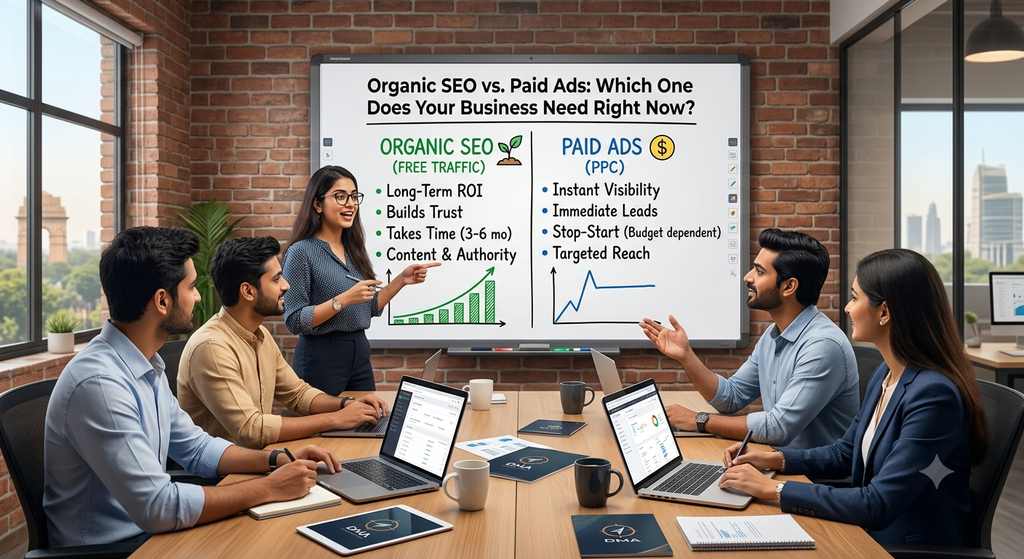
- Long-Term ROI: Once your content ranks, it can drive consistent, continuous traffic for months—or even years—without paying per click.
- Builds High Trust & Credibility: Users often trust organic search results more than sponsored ads. High search rankings position your brand as an industry leader.
- Cost-Effective Over Time: While SEO requires upfront time and effort, the cost per lead drops significantly as your organic traffic grows.
The Cons of Organic SEO
- Takes Time: SEO is a long-term game. It usually takes 3 to 6 months (or longer) to see significant results.
- Requires Constant Updates: Search engine algorithms change frequently, requiring ongoing content updates and technical maintenance.
Understanding Paid Ads (PPC)
Paid Advertising—such as Google Search Ads, Meta Ads (Facebook & Instagram), or LinkedIn Ads—allows you to pay for immediate visibility.
You bid on target keywords or audience demographics, and your ads appear at the top of search results or social media feeds.
The Pros of Paid Ads
- Instant Traffic & Results: Your campaign can go live today, and you can start getting visitors and leads within hours.
- Hyper-Targeted Reach: You can target prospects down to their location, age, interests, behavior, and job titles.
- Highly Scalable & Measurable: You know exactly how much you spent and how many sales or leads you generated down to the dollar.
The Cons of Paid Ads
- Traffic Stops When Budget Stops: The moment you stop spending money, your lead flow dries up completely.
- Ad Fatigue & Rising Costs: Keyword competition can drive up Cost-Per-Click (CPC), making ads expensive over time if not continuously optimized.
Head-to-Head Comparison
| Feature | Organic SEO | Paid Ads (PPC) |
| Speed to Results | Slow (3–6+ months) | Instant (Hours to days) |
| Upfront Cost | Moderate (Strategy & Creation) | High (Ad Spend + Management) |
| Long-Term Value | Very High (Compounding Growth) | Low (Dependent on budget) |
| Trust Factor | High (Earned authority) | Moderate (Recognized as sponsored) |
| Audience Targeting | Intent-based (Keywords) | Intent & Demographic-based |
Which One Does Your Business Need Right Now?
To decide where to allocate your marketing budget today, look at your primary goal:
Choose Paid Ads if:
- You need immediate leads or sales (e.g., product launches, seasonal offers, urgent service calls).
- You are a brand-new business with zero search visibility or website authority.
- You want to test a new offer or message quickly before making a large investment.
Choose Organic SEO if:
- You want a sustainable, predictable customer acquisition pipeline that lowers marketing costs over time.
- You operate in an industry with high Ad CPCs, making paid ads unprofitable for long-term growth.
- You want to establish authority and brand presence in your niche.
The Hybrid Approach: Why Not Both?
If your budget allows, the ultimate growth strategy is combining both:
- Use Paid Ads for immediate revenue while your SEO foundation is being built.
- Use Google Ads data to discover high-converting keywords, then create SEO content around those exact keywords for long-term organic ranking.